

The quick answer: before your first day back at work, aim for 3 to 5 workdays of milk in the freezer — for most schedules, roughly 36 to 80 ounces. Not a freezer full, and not the hundreds of ounces in the photos that made you anxious. Your exact number comes from one multiplication: the hours you will be away, times 1 to 1.5 ounces per hour, times the buffer days you want. Our free Breast Milk Stash Calculator does that maths with your return date and your daily pumping extra, and tells you the date you will reach your goal — this guide explains the reasoning so you can trust (or challenge) any number anyone gives you.
The freezer-full myth, retired
Open any parenting feed and you will find a deep freezer stacked with 500, 800, a thousand ounces, captioned like an achievement. What those posts never mention: a stash is a buffer, not a supply. Once you are back at work, the milk you pump on Monday is the milk your baby drinks on Tuesday. The freezer exists for the first few days before that rhythm starts, for the day a bottle spills, the week a growth spurt hits, or the morning you are too sick to pump. Lactation consultants consistently land in the same place: 3 to 5 days of milk is a solid, professional-grade goal. More is fine if it comes easily. Chasing it at the cost of sleep and sanity is not the assignment.
The one rule every number comes from
Between about one and six months, a breastfed baby takes in roughly 24 to 30 ounces a day in total, and the pace is remarkably steady: about 1 to 1.5 ounces for every hour of separation. That single rule generates your whole plan, because a workday of milk is just your hours away — door to door, commute included — multiplied by that rate:
| Hours away (with commute) | Milk per workday at 1 oz/hr | At 1.25 oz/hr | At 1.5 oz/hr |
|---|---|---|---|
| 4 hours | 4 oz | 5 oz | 6 oz |
| 6 hours | 6 oz | 7.5 oz | 9 oz |
| 8 hours | 8 oz | 10 oz | 12 oz |
| 9 hours | 9 oz | 11.3 oz | 13.5 oz |
| 10 hours | 10 oz | 12.5 oz | 15 oz |
| 12 hours | 12 oz | 15 oz | 18 oz |
Most parents plan with the middle column. If your baby is a famously enthusiastic feeder, or your caregiver tends to offer a bottle at every fuss, use the right-hand column for peace of mind.
From one workday to your goal
Multiply one workday by your buffer. Three workdays is the minimum most consultants suggest; five — one full work week — is the comfortable standard; ten is for parents who travel, work irregular shifts, or simply sleep better with a deeper bench:
| One workday of milk | 3-day buffer | 5-day buffer | 10-day buffer |
|---|---|---|---|
| 10 oz | 30 oz | 50 oz | 100 oz |
| 11.3 oz | 34 oz | 56 oz | 113 oz |
| 12.5 oz | 38 oz | 63 oz | 125 oz |
| 15 oz | 45 oz | 75 oz | 150 oz |
Read the table against the myth: even the deepest sensible goal on it — 150 ounces — is a fraction of the freezer monuments online. And in bags, the standard 56-ounce goal is about 14 to 15 bags of 4 ounces. That is a plan, not a second job.
When to start: two dates, not one
Your supply date: wait until breastfeeding and your supply are established — usually around 4 to 6 weeks after birth — before adding extra pumping sessions. Pumping hard in week one can create an oversupply, which sounds like a prize and behaves like a problem. Your build date: start collecting about 3 to 4 weeks before your return. At a realistic 3 to 4 extra ounces a day, that window produces 60 to 110 ounces — the whole goal, built gently. Starting in the final week is the common mistake: the maths stops working, and a calm routine turns into emergency pumping. The stash calculator exists precisely to catch that early: enter your return date and it flags a shortfall weeks ahead, when one extra short session still fixes it.
How the daily extra actually happens
The workhorse session is the one after the first morning feed, when supply is naturally at its highest. Most mothers collect 1 to 2 ounces after a feed, or 2 to 4 ounces from one dedicated session between feeds. That is the entire engine: 3 ounces a day, banked daily, is 90 ounces in a month. Two practical notes from everyone who has done this: consistency beats intensity (daily small sessions move supply and stash further than weekend marathons), and every ounce counts at the start — a 20-ounce head start is already two workdays of freedom.
Portions, labels and the first-in-first-out rule
Freeze in 2 to 4 ounce portions — one feeding per bag. Thawed milk must be used within 24 hours and can never be refrozen, so a bag bigger than a feeding is a waste waiting to happen. Leave an inch of room at the top (milk expands as it freezes), write the date on every bag, freeze bags flat so they stack and thaw quickly, and always use the oldest milk first. Keep a simple running total on the freezer door or in your notes — knowing you hold 48 ounces, not "some bags", is the difference between a plan and a hope.
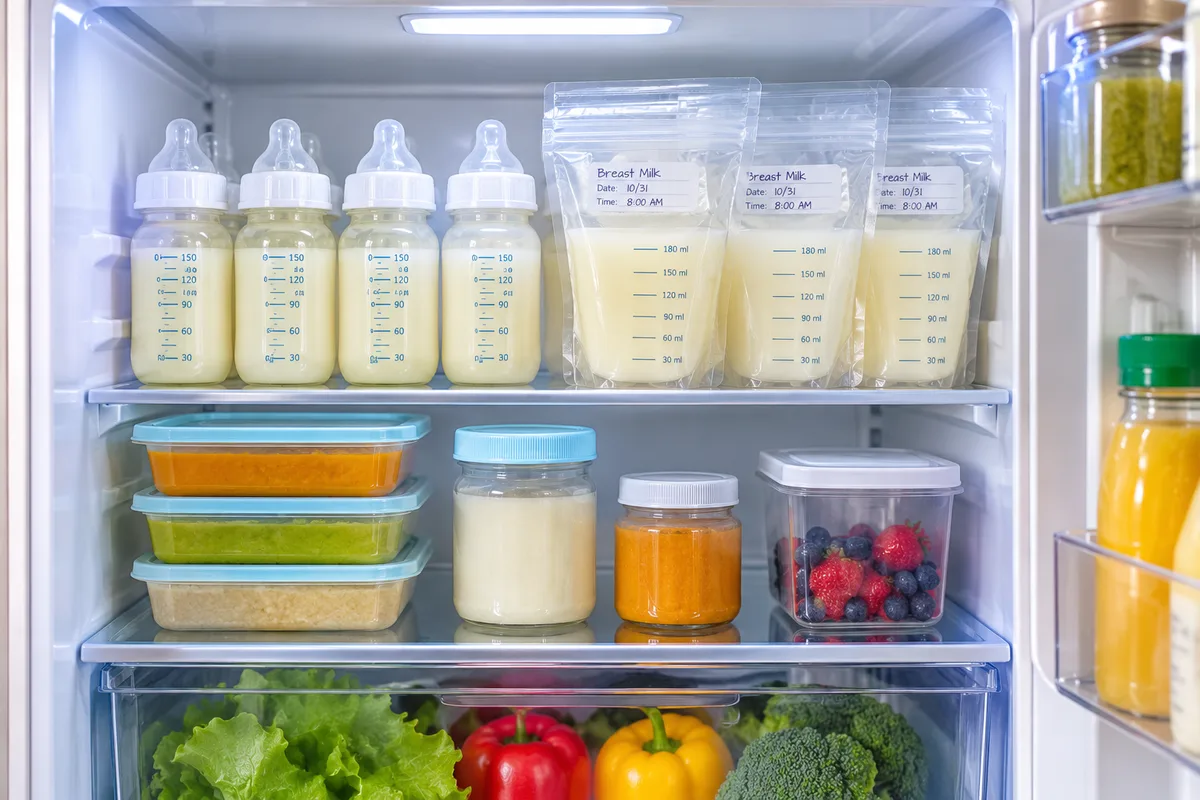
Fridge storage follows the 4-day rule below.
Storage rules that are not negotiable (CDC)
| Where | Freshly pumped milk keeps |
|---|---|
| Room temperature (up to 77°F / 25°C) | Up to 4 hours |
| Cooler bag with frozen ice packs | Up to 24 hours |
| Refrigerator (40°F / 4°C or colder) | Up to 4 days |
| Freezer (0°F / -18°C or colder) | Best within 6 months; up to 12 months acceptable |
Thawed milk gets its own stricter clock: 24 hours in the fridge, 1 to 2 hours at room temperature, and never refreeze it. Thaw overnight in the fridge or under warm running water — never in a microwave, which creates hot spots and damages the milk. If your baby does not finish a bottle of thawed milk, the clock is unforgiving; that is the practical reason small bags win.
How long will the stash last once you are back?
Divide your stash by one workday of milk. Sixty ounces against an 11-ounce workday is about five workdays — except that in real life the stash barely drains, because each day at work you pump roughly what your baby drank. Watch the level like a fuel gauge instead: if it trends down week after week, you have a supply question to raise early, with time to fix it. If it holds or grows, you are done building — freeze your energy for the baby instead. And while you are in planning mode, the other consumable new parents famously misjudge is diapers: our diaper stockpile guide shows why the first year takes about 2,700 of them — and why only about 140 are Newborn size.
Everything you need for your stash
Pre-sterilised, single-use bags that freeze flat and thaw fast — the standard choice for building a freezer stash, in the 4–6 oz portions this plan is built around.
A hospital-grade double electric pump with a rechargeable battery — the pump many working mums use to add the one extra daily session this plan counts on.
A freezer tray and container that holds up to 10 bags frozen flat and in date order, so first-in, first-out happens on its own.
As an Amazon Associate, ToolFoxHub earns from qualifying purchases made through these links — it never adds to the price you pay. Prices and availability are shown on Amazon and can change at any time.
Frequently asked questions
How much breast milk should I store before returning to work?
Three to five workdays of milk — about 36 to 80 ounces for most schedules. Calculate yours as hours away (with commute) × 1 to 1.5 oz per hour × buffer days. A 9-hour day at the typical 1.25 oz rate is about 11.3 oz, so a 5-day buffer is roughly 56 oz — about 15 bags of 4 oz.
When should I start pumping to build a stash?
Start collecting about 3 to 4 weeks before your return date, and only once your supply is established (around 4 to 6 weeks after birth). At 3 to 4 extra ounces a day, that window comfortably builds a full 5-day buffer.
Is a 200-ounce stash necessary?
No. It is more than double the standard 5-workday buffer for almost every schedule, and hundreds of ounces beyond that have no practical purpose for a parent who will pump at work. Large stashes make sense for specific situations — long travel, medical separations, exclusively pumping — not as a general requirement.
Can I build a stash while exclusively breastfeeding?
Yes — that is how most stashes are built. Add one pumping session a day, usually after the first morning feed, and freeze the extra. Even 1 to 2 ounces a day becomes a workday of freedom every week.
How long does a freezer stash stay good?
In a freezer at 0°F (-18°C) or colder, breast milk is best within 6 months and acceptable up to 12 months per the CDC. Use the oldest bags first, and once milk is thawed, use it within 24 hours and never refreeze it.