
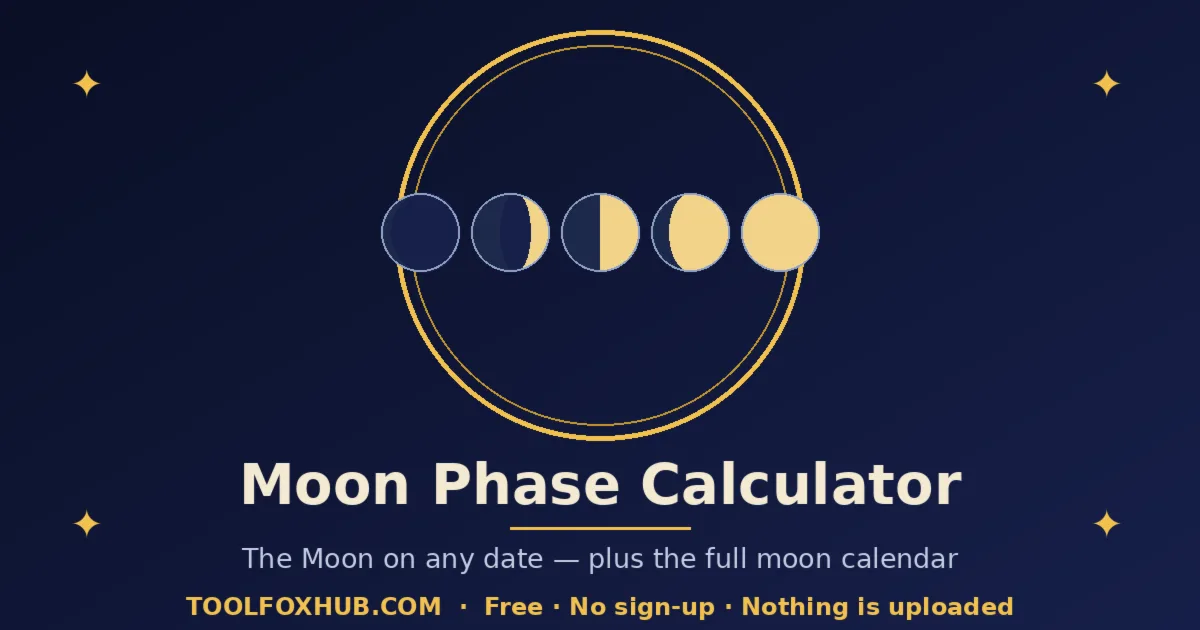
What the moon phase means
The Moon does not change - our view of its lit half does. As the Moon orbits the Earth every 29.53 days, the angle between the Sun, Earth and Moon (the elongation) grows from 0 degrees at new moon, through 90 at first quarter, to 180 at full moon, and back. This calculator takes the real Sun and Moon positions for your date from the same astronomical engine as our Moon Sign Calculator, measures that angle, and turns it into the phase name, the percentage lit, and the Moon's age in days - plus the exact dates of the next full and new moons, found by tracking the angle until it crosses 180 and 360 degrees.
The eight phases, in order
| Phase | What you see | Days into the cycle |
|---|---|---|
| 🌑 New Moon | Dark disc - the lit side faces away from us | 0 |
| 🌒 Waxing Crescent | A sliver of light on the right (northern hemisphere) | 1-6 |
| 🌓 First Quarter | Right half lit | ~7.4 |
| 🌔 Waxing Gibbous | More than half lit and growing | 8-14 |
| 🌕 Full Moon | The whole face lit - rises at sunset, up all night | ~14.8 |
| 🌖 Waning Gibbous | Light shrinking from the right | 15-21 |
| 🌗 Last Quarter | Left half lit | ~22.1 |
| 🌘 Waning Crescent | A thinning sliver on the left, heading back to new | 23-29 |
In the southern hemisphere the picture is mirrored - the light grows from the left. The full moon names in the calendar are the traditional North American and European names for each month's full moon: the Beaver Moon in November, the Cold Moon in December, the Wolf Moon in January, and so on. A second full moon inside one calendar month is the famous Blue Moon - the most recent fell on May 31, 2026.
Moon phase on your birthday
Pick your birth date above and the calculator shows the Moon you were born under - the same Moon astronomers recorded that day. Astrology readers: this is the phase, while your moon sign is the zodiac sign the Moon was passing through - the two together are the full picture. Photographers and gardeners use the calendar the other way round: the highlighted row is the next full moon, with the count of days left to plan around it.
More sky tools: Astrology Calculators - Sun Sign Calculator - Sun, Moon & Rising Calculator.
Frequently asked questions
When is the next full moon?
The calendar on this page always highlights it: the next full moon is the Beaver Moon on Tuesday, November 24, 2026, with the Cold Moon following on December 23-24, 2026 (dates in UTC - your local date can differ by a day either side of the world). The calculator also counts down the days from any date you pick.
What was the moon phase on my birthday?
Enter your birth date in the calculator and it shows the exact phase, the percentage of the disc lit, and the Moon's age that day - computed from the real positions of the Sun and Moon, for any date in the modern era.
How often is a full moon?
Every 29.53 days on average - the length of the lunar cycle - so most months have one full moon and some have two. The second one in a month is called a Blue Moon, which happens about once every two to three years.
Why does the moon look different in Australia or the southern hemisphere?
The phase is the same worldwide, but it appears mirrored: in the southern hemisphere the lit part grows from the left instead of the right, because you are looking at the Moon from the opposite orientation. The drawing on this page shows the northern-hemisphere view.
Is the full moon the same date everywhere?
The instant of full moon is one moment worldwide, but your local date for it depends on your time zone - a full moon early in the UTC morning is still the previous evening in the Americas. Calendar dates here are given in UTC.
What is a supermoon?
A full moon that falls when the Moon is near perigee, its closest point to Earth in its elliptical orbit. It looks up to about 14% larger and 30% brighter than the smallest full moon of the year. The difference is subtle in photos but noticeable side by side.