Why journal at Christmas at all
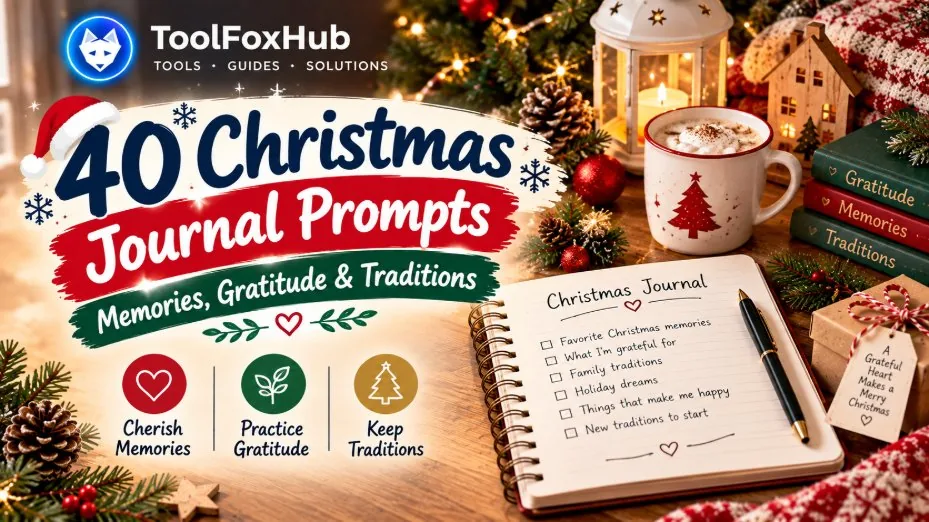
December is the most documented month of the year in photographs and the least documented in words. Phones fill with pictures of trees and tables, and almost nothing records what it all felt like, who said what, or why this year's dinner was funny in a way next year's will not be. A Christmas journal fixes that in the cheapest possible way: a notebook, a pen, and fifteen minutes. The prompts below are the hard part done for you — forty questions in four groups, written to pull out memories, gratitude, family stories and a few letters to the future. You do not need to be a writer. Most of these are answered best in plain sentences by tired people, which is exactly the handwriting the future wants to read.
How to use these prompts
Pick one prompt a day through December, or raid them in groups when you have a quiet half hour — the groups are designed to work together: Memories for early December nostalgia, Gratitude for the middle of the month, Traditions for the days around Christmas itself, and Letters to the Future for the strange quiet week after. Write longhand if you can; a Christmas journal is one of the few things that gets more valuable as the handwriting gets worse. If you are pairing this with our Self-Care Advent Calendar, each door there carries its own short journal prompt — these forty are the deeper bench for when a door's question opens something bigger. There are no wrong answers and no audience: write like nobody will read it, then keep it somewhere somebody eventually will.
The 40 Christmas journal prompts
Memories worth keeping
1. Write about the best Christmas of your childhood. What actually made it the best?

2. Describe the Christmas tree of your childhood home — real or artificial, and who decorated it?
3. What is the worst gift you ever received, and can you laugh about it now?
4. Write about a Christmas when the weather changed everyone's plans.
5. Who cooked Christmas dinner when you were a child, and what was always on the table?
6. Which Christmas song instantly takes you back — and to where?
7. Describe a present you wanted desperately as a child. Did you get it?
8. Write about a Christmas you spent away from home.
9. What did Christmas Eve feel like when you were seven?
10. Which decoration from your childhood would you rescue first?
Gratitude, December edition
11. Name three people who made this year easier — and write one sentence of thanks to each.
12. What small thing went right this December that you almost missed?
13. Which ordinary object are you grateful for every single December?
14. Write about help you received this year that you never properly acknowledged.
15. What hard thing from this year taught you something you needed?
16. Who would you thank for your favourite smell of Christmas?
17. List five things about your home you are grateful for this winter.
18. What did someone teach you this year, for free, that you now use every week?
19. Write a thank-you to a stranger whose kindness you still remember.
20. Which part of Christmas Day are you most grateful still exists?
Traditions and family stories
21. Write down one family tradition exactly as it happens, step by step, so it is never lost.
22. Where did your family's most unusual tradition come from?
23. What one question would you ask an older relative about their childhood Christmases?
24. Which tradition would you keep if you could keep only one?
25. Which tradition are you ready to retire, and what would take its place?
26. Write the story of your family's favourite recipe. Who made it first?
27. Describe how your family opens presents: the order, the rules, the chaos level.
28. What did your grandparents' Christmas look like, as far as you know?
29. Invent one new tradition for next year and write down how it begins.
30. Which tradition do the children in your family think is ancient, but is actually new?
Letters to the future
31. Write a letter to yourself to open next 1 December. What should you remember?
32. What do you hope is different about your life by next Christmas?
33. Write to a child in your life: what is Christmas like right now, in this house?
34. What one thing would you tell next December's you about money and gifts?
35. Describe this Christmas in five sentences, for someone reading in fifty years.
36. What should future you stop doing in December?
37. Write a message to someone you miss, to be read on Christmas Eve.
38. What do you want your Christmases to feel like in ten years?
39. Leave one piece of advice here for a brand-new parent's first Christmas.
40. Finish this sentence, then keep going: 'This year, Christmas taught me...'
Keeping the habit (and the notebook)
Three small decisions decide whether a Christmas journal becomes a tradition or a one-year wonder. Keep the notebook with the decorations. When it lives in the Christmas box, it reappears every December without anyone remembering to remember it, and last year's entries become part of taking the decorations out. Date every entry, even just the year — "the Christmas the boiler broke" is a fine story in 2035 only if you can tell which year it was. Let other people in occasionally. One evening a year, pass the notebook around after dinner with the traditions prompts and let everyone write one answer in their own hand, children included (dictated counts). A journal with six handwritings in it stops being a diary and becomes the family's archive — which is what our self-care advent ideas mean when they talk about memories being a form of rest: you cannot lose what you have written down.
Frequently asked questions
How long should each entry be? As long as it wants to be. A honest paragraph answers most of these prompts; some (the family stories especially) will run for pages once you start. Set a timer for fifteen minutes if finishing matters more than depth.
Paper notebook or phone? Paper, if you can — it survives app changes, gets found by grandchildren, and cannot be lost in a phone upgrade. If a notes app is genuinely what you will use, use it without guilt and export a copy each January.
What if a prompt makes me sad? Some will — gratitude and memory live next door to missing people. Skip any prompt that costs too much this year; the calendar and this list will both be here next December, and a skipped page is also a true record.
Can children use these prompts? The traditions and memories groups work well read aloud to children, who give gloriously unfiltered answers worth writing down verbatim. The letters-to-the-future group is mostly for adults — although a seven-year-old's letter to next December is the single best thing in most family journals.