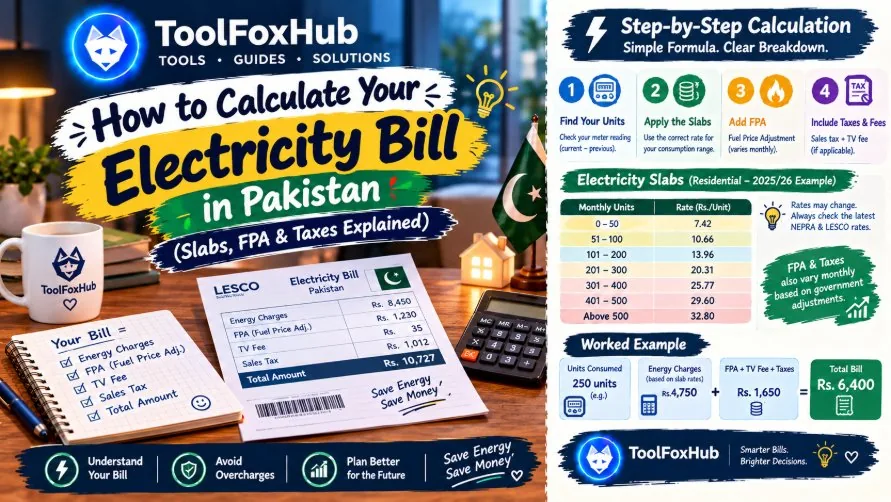
How to calculate your electricity bill in Pakistan: the short answer
Your bill is a stack of charges, not a single multiplication. The full formula is: energy charge + fixed charge + FPA + QTA + surcharges + 1.5% electricity duty + 18% GST + Rs 35 TV fee (plus 7.5% income tax for non-filers on bills of Rs 25,000 or more). The part most people get wrong is the energy charge itself: unprotected consumers pay the rate of the slab they reach on ALL their units, while protected consumers pay slab by slab. Everything else is arithmetic. If you want the instant version, the Electricity Bill Calculator Pakistan does the whole stack, with editable rates, in one place.
The slab system
Domestic tariffs are divided into consumption slabs. The unprotected slabs (February 2026 schedule, the most-cited table) are: 1–100 units at Rs 22.44, 101–200 at Rs 28.91, 201–300 at Rs 33.10, 301–400 at Rs 37.99, 401–500 at Rs 40.20, 501–600 at Rs 41.62, 601–700 at Rs 42.76, and above 700 at Rs 47.69. The protected slabs are far cheaper: the first 100 units at Rs 10.54 and the next 100 at Rs 13.01. Lifeline consumers (up to 100 units) pay Rs 3.95 for the first 50 units and Rs 7.74 for units 51–100, with no fixed charge and a minimum bill of Rs 75.
One warning before the examples: published tariff tables disagree with each other, especially on the higher slabs. Some sources list 36.46 instead of 37.99 for 301–400 units, 38.95 instead of 40.20 for 401–500, and up to 48.84 for 700+ units, while some popular calculators still show older tables entirely. The defaults in the calculator follow the February 2026 schedule, but every rate there is editable — if your printed bill shows a different rate, type it in. NEPRA kept the tariff unchanged for calendar 2026, but FPA and QTA move regularly, so the editable fields matter more than any single printed table.

Protected vs unprotected: the rule that changes everything
A protected consumer is a domestic consumer whose average usage over the last 6 months is 200 units or less. Protected billing is progressive: each block of units is charged at its own slab rate. A protected household using 200 units pays 100 × 10.54 + 100 × 13.01 = Rs 1,054 + Rs 1,301 = Rs 2,355 for energy. An unprotected consumer — anyone averaging above 200 units — is charged the reached-slab rate on every unit. An unprotected household using 200 units pays 200 × 28.91 = Rs 5,782 for energy. Same 200 units, more than double the energy charge. And at 300 units, the unprotected energy charge is 300 × 33.10 = Rs 9,930, not the 100 × 22.44 + 100 × 28.91 + 100 × 33.10 = Rs 8,445 that a slab-by-slab reading would suggest. That Rs 1,485 difference is the flat-rate rule at work, and it is the single biggest reason unprotected bills surprise people.
Worked example: a 300-unit LESCO bill, line by line
Take a published breakdown for a 300-unit unprotected LESCO bill with a 1 kW sanctioned load, using that month's actual adjustments (FPA Rs 2.0581 per unit, QTA Rs 0.5194 per unit, no separate surcharge in that breakdown):
| Charge | Calculation | Amount |
|---|---|---|
| Energy charge | 300 × 33.10 (flat slab rate) | Rs 9,930 |
| Fixed charge | Rs 350/kW × 1 kW | Rs 350 |
| FPA | 300 × 2.0581 | Rs 617 |
| QTA | 300 × 0.5194 | Rs 156 |
| Electricity duty (1.5%) | 1.5% × (9,930 + 617 + 156) | Rs 161 |
| GST (18%) | 18% × (9,930 + 350 + 617 + 156 + 161) | Rs 2,018 |
| TV fee | Flat | Rs 35 |
| Total | Rs 13,267 |
Notice two things. First, the energy charge alone (Rs 9,930) is only about three-quarters of the bill — taxes and adjustments add more than Rs 3,300 on top. Second, the duty is charged on energy + FPA + QTA (not on the fixed charge), while GST is charged on everything including the duty. That ordering — duty before GST, GST on the duty — is why adding up the percentages in your head (1.5 + 18 = 19.5%) understates the tax: the effective tax on the energy charge is higher, because GST applies to the duty as well.
The 200-unit cliff
Because unprotected billing reprices all units at the higher slab rate, crossing from 200 to 201 units does not cost one unit at the old rate — it reprices all 201 units at Rs 33.10 instead of Rs 28.91. With default rates and a 2 kW load, a 200-unit unprotected bill is about Rs 8,413, while a 201-unit bill is about Rs 9,578: one extra unit costs about Rs 1,165. And the bigger cliff is status itself: averaging above 200 units over 6 months costs you protected status, which for a 200-unit month is the difference between about Rs 4,309 (protected, 2 kW) and Rs 8,413 (unprotected, 2 kW) — roughly double. Staying under 200 units on average, about 6–7 units a day, is the single most valuable habit in Pakistani electricity billing.
What FPA and QTA actually are
FPA (Fuel Price Adjustment) passes changes in fuel prices through to consumers, revised monthly. It is the most volatile part of the bill: in different months it has ranged from about Rs 0.48 to about Rs 3.50 per unit, which on a 300-unit bill is a swing of roughly Rs 900. If two months with identical usage have very different bills, FPA is the first suspect. QTA (Quarterly Tariff Adjustment) is a quarterly revision (Rs 0.5194 per unit for April–June 2026) covering cost changes the base tariff does not. Both are per-unit charges, so both grow with usage — and both are editable in the calculator, because no fixed default stays right for long.
Why your bill differs from the calculator
Four usual causes, in order of likelihood: arrears or a previous balance carried onto the bill (the single most common reason — check the “arrears” line on your printed bill first); a higher FPA that month; a larger sanctioned load than you assumed (the fixed charge scales with kW, so a 5 kW load costs much more in fixed charges than a 1 kW load); and a slab rate that has changed since the defaults were set. Meter-reading errors and estimated (rather than actual) readings are a fifth cause — if your bill says “estimated”, the units themselves may be wrong, and no calculator can fix that; only a corrected reading from your DISCO can.
How to read your bill (and what to check first)
Your printed bill has a few lines worth learning: the reference number (14 digits — this is what you need to check or pay your actual bill on your DISCO's website or app, and it is something no estimator can replace); previous and present readings (their difference is your units — if either looks wrong, that is your first complaint); sanctioned load in kW (drives the fixed charge); slab-wise units (shows whether you were billed protected or unprotected); and the FPA, QTA, duty, GST and TV fee lines. If the slab-wise section shows a flat rate on all units, you were billed unprotected; if it shows two blocks at 10.54 and 13.01, you were billed protected. That one check resolves most “why is my bill so high?” questions.
How to stay protected (and cut the bill generally)
Keep the 6-month average at or below 200 units. The heavy consumers in most Pakistani homes are air conditioners (by far the biggest), electric heaters, water heaters (geysers) and old refrigerators. Practical steps that actually move the number: run the AC at 26°C instead of 22°C, switch the geyser off when not needed (or to a timer), replace old bulbs with LEDs, and check whether an old fridge is drawing far more than its rating. Shifting heavy use to off-peak hours does not change the unit count, so it does not help the protected average — only using fewer units does. And remember: one heavy month does not automatically cost you protected status, because the test is the 6-month average — but two or three heavy months in a row will.
Frequently asked questions
How do I calculate my electricity bill in Pakistan?
Energy charge (units × slab rate, flat-rate for unprotected, slab-by-slab for protected) + fixed charge (per-kW rate × load) + FPA + QTA + surcharges + 1.5% duty + 18% GST + Rs 35 TV fee. Use the Electricity Bill Calculator Pakistan for the full breakdown with your own rates.
What is the per-unit price of electricity in Pakistan in 2026?
There is no single per-unit price: it depends on your slab and consumer type. Unprotected rates run from Rs 22.44 (up to 100 units) to Rs 47.69 (above 700 units); protected rates are Rs 10.54 and Rs 13.01; lifeline rates are Rs 3.95 and Rs 7.74. And the all-in cost per unit — after fixed charges, FPA, QTA, duty and GST — is always higher than the slab rate alone.
What is the difference between protected and unprotected consumers?
Protected consumers (6-month average ≤ 200 units) pay slab by slab at the cheaper protected rates. Unprotected consumers pay the reached-slab rate on all units, which roughly doubles the energy charge at the same usage.
What is FPA in an electricity bill?
The Fuel Price Adjustment: a monthly per-unit charge reflecting fuel price changes. It is the most volatile part of the bill and the most common reason two identical-usage months differ.
Can I check my actual bill with a calculator?
No. An actual bill check needs your 14-digit reference number on your DISCO's official website or app. Calculators estimate what a bill should be — they cannot fetch, verify or pay your real bill.
The bottom line
Electricity billing in Pakistan is a stack, not a single rate — and the slab rule (flat for unprotected, progressive for protected) is the part that matters most. Learn your consumer type, watch the 200-unit average, check FPA on any surprising bill, and use the Electricity Bill Calculator Pakistan to see the full breakdown before the bill arrives. For the tax side generally, see also How to Calculate GST in Pakistan.