How to choose a Christmas gift: the short answer
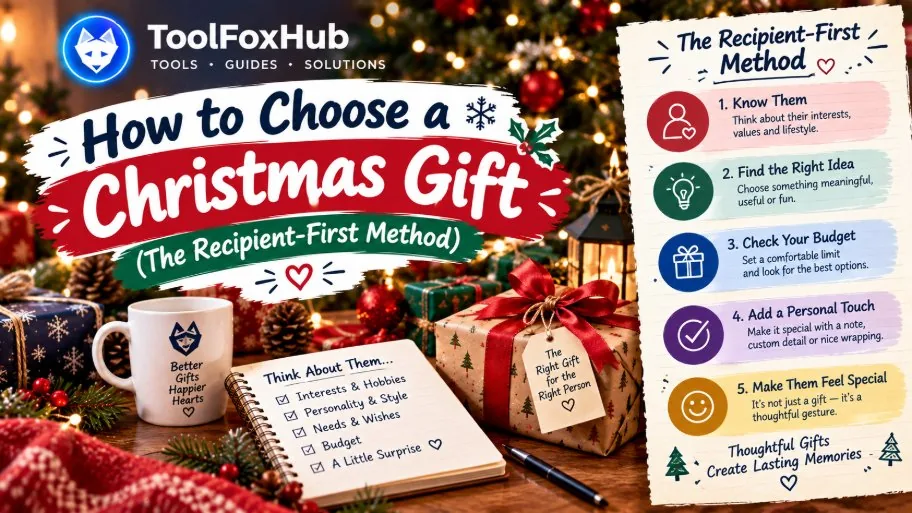
Start with the person, not the product. Before you open a single gift guide, answer three questions: what do they already do every day, what have they mentioned wanting or complaining about this year, and what would they never buy for themselves? The overlap of those three answers is almost always the right gift. Everything else in this guide - budgets, types, timing - is just a way to sharpen that answer. And if you want the shortcut, the Christmas Gift Finder turns the same method into four questions and six matched ideas in under a minute.
The recipient-first method
Most people shop backwards: they open a list of "best gifts", pick something that looks good, and then try to match it to a person. That is why so many presents end up in a drawer. The recipient-first method reverses it. First, write down what the person actually does: their morning routine, their evenings, their weekends, their work. A gift that fits a routine they already have - a better version of the coffee gear they use daily, a warmer version of the scarf they wear - gets used from December 26 onwards. A gift that requires a new routine - a hobby kit for a hobby they do not have, a gadget for a problem they do not feel - needs willpower, and willpower is in short supply in January. The single most reliable test in all the current guides is this: choose a gift for a ritual they already have, not one you hope they will start.
Three things to separate: interests, needs, sentiment
People mix up three different things when they choose, and separating them makes the decision much easier. Interests are what the person enjoys doing: cooking, reading, music, sport, gardening. A gift tied to a real interest almost always lands, because it shows you were paying attention. Needs are what would make daily life easier: a broken thing replaced, a daily annoyance fixed, a missing item supplied. Needs-based gifts are the safest of all - the warped cutting board they keep mentioning, the phone charger that actually reaches the bed, the wallet falling apart at the seams. Small complaints and repeated wishes during the year are more reliable than any gift guide, because the person has already told you what is missing. Sentiment is what connects to people or memories they care about: a photo, a date, a place, a shared joke. Sentimental gifts work best for partners and close family, where the shared history is the point. A good gift usually serves one or two of these three - rarely all three, and that is fine. What you should decide, before you shop, is which one you are aiming for. "Meaningful" usually comes down to a concrete link: a hobby they mentioned, a family photo they love, a routine like morning coffee. Vague meaningfulness - a generic "personalized" item with no real connection - is just an expensive way of saying you did not know what to buy.

Budget by relationship: what people actually spend
Budget is where guilt does the most damage. The current US guides put typical ranges at roughly: coworkers and teachers $15-$30, friends $20-$50, parents $75-$150, partners $150-$250. European budgets run lower across the board. These are benchmarks, not rules, and two things matter more than any table. First, list length: ten people on a $500 budget means $20 presents for most of them, and that is fine - a $20 gift chosen well beats a $100 gift chosen blindly. Second, whether adults in the family have agreed to change the rules: Secret Santa for the wider circle, one gift per household instead of per person, or adults agreeing to stop swapping presents entirely. Cutting the list almost always helps more than cutting every gift, because it lets the remaining gifts be properly chosen instead of panic-bought. Before you set any budget, open the Christmas Budget Calculator, list every recipient with a price, and let the total tell you whether the plan is real. A budget set after the shopping has started is not a budget - it is a regret.
The "has everything" problem, solved
Every family has one: the person who says "I don't need anything" and means it, because they genuinely own everything they want. The search data and the guides agree on the answer, and it has three parts. First, buy an experience, not an object. A cooking class, concert tickets, a tasting, a day out - a memory does not need shelf space, and people remember time with family longer than they remember another item. The important part is to make the plan concrete: choose a date, a place, an activity. "We should go someday" is not a gift; a booked table is. Second, upgrade something they already use daily. A quality travel mug for the coffee they already drink, a better wallet for the one falling apart, a proper knife for the cook - these work because they do not create a new habit, they improve one that already exists. Third, personalize. A name, a date, a photo, a shared joke - the one thing a shop cannot already sell them. If even that fails, the honest fallback is a donation in their name or a truly good consumable: a food hamper gets eaten, which is the point. The Gift Finder has a dedicated option for this recipient and weights experience first, personalized second, and practical upgrades third, for exactly this reason.
Timing: the deadline most people miss
The second-biggest cause of bad Christmas gifts is not taste - it is timing. Personalized gifts are made to order, often 5-7 business days before shipping, and many sellers set mid-December cutoffs. Order a custom item on December 20 and it arrives in January, however good the idea was. The safe line is early December for anything personalized. For normal posted gifts, US services suggest around December 17 (Ground Advantage), December 18 (Priority) and December 19 (Express) for delivery before Christmas; other countries have their own cutoffs, so check your local post rather than assuming the US dates. Digital gifts have no deadline at all - streaming, audiobooks, courses and e-gift cards can be bought on Christmas morning and still count. And anything from a local shop is available until the shops shut. If you are reading this in the last week before Christmas, skip the posted ideas entirely and read the last-minute gifts guide instead - it is a different game with different rules, and the rules are kinder than you think.
Five mistakes to stop making
- Buying for yourself. The test is simple: would they pick this, or would you? If the answer is you, it is not their gift, however beautiful it is.
- Buying what they already own. Someone who owns three coffee makers does not need a fourth. The "upgrade" rule - a better version of what they use - beats the "another one" rule every time.
- Ignoring the return policy. A bargain with no returns is not a bargain, especially for clothing sizes, tech, and anything the recipient might already own.
- A gift card with no note. Gift cards are fine - especially last-minute - but a card that says why you chose that store is a gift, while a bare card is an errand. Ten seconds of handwriting fixes it.
- Leaving it to the last weekend. Late shopping does not just limit choice, it changes what you buy: the last weekend produces generic gifts, because the good ones needed a decision you did not make in time. Decide the list in November, even if you buy in December.
For couples, family, and coworkers: different logics
A present for a partner follows a different logic from a present for a relative, because it draws on shared history and private references - an inside joke, a shared trip, a date that matters. For relatives, the better test is simpler: does it fit the person's daily life and interests, not whether it carries a big emotional message. Practical gifts can read as impersonal to some people and as deeply thoughtful to others - the difference is whether the practical thing is something they actually wanted fixed. If you are unsure, the safest combination in all the guides is a useful item with a small personal touch: a handwritten note explaining why you chose it covers both, and costs nothing. For coworkers and teachers, keep it small, consumable, and free of awkwardness: good coffee, good chocolate, a candle, a plant. Nobody has ever been offended by a small consumable, and everybody has been made uncomfortable by an expensive, personal gift from someone they barely know.
The bottom line
Choosing a Christmas gift is not a talent - it is a method. Start with the person, separate interests from needs from sentiment, set the budget from the list rather than from guilt, solve "has everything" with experiences and upgrades, and respect the ordering deadlines. Do those five things and the gift almost chooses itself. And if you want the method done for you, open the Christmas Gift Finder, answer four questions, and pick from six ideas matched to the person, the budget, the interest and the type - with the order-by warning attached to each one, so the gift you choose is also a gift that arrives on time.