How much to spend on Christmas? The short answer
A good starting point is one week of your take-home pay — half a week if money is tight, one and a half weeks only if savings and goals are on track. On $60,000 of annual take-home pay, that is about $580 (tight), $1,150 (steady) or $1,730 (comfortable). A second rule of thumb says about 1% of annual income. Both are starting points, not laws: your real number comes from your bills and your gift list, and the Christmas Budget Calculator works it out from exactly those two things. The rest of this guide explains the averages behind the rules, what to spend per person, and where the money actually goes.
What the 2026 averages say (and why they disagree)
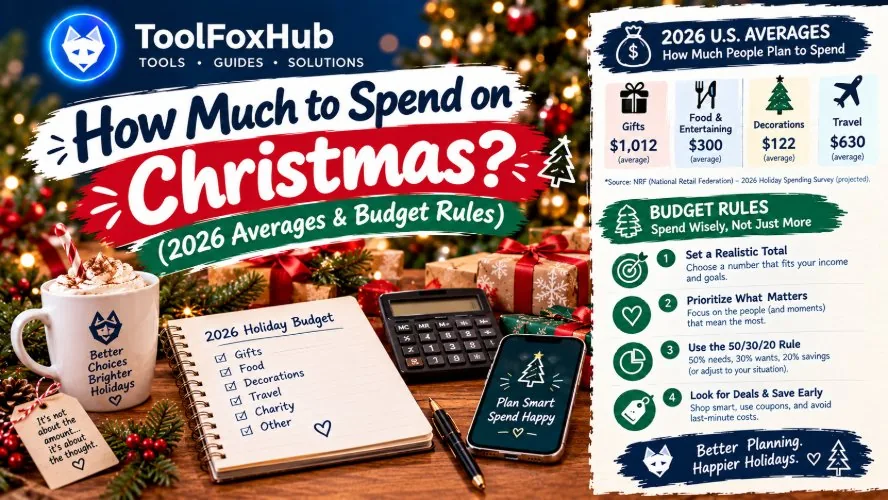
Every survey gives a different number because each measures something different. For 2026: NerdWallet puts expected holiday spending at $2,525 per holiday spender in total (gifts, travel and parties), with $879 on gifts alone. Gallup puts expected gift spending at $1,007. PwC puts planned gift spending at $708. Deloitte's household estimate for retail goods and activities is $1,654. A family of four lands around $3,500–$4,000 in total. In the UK, the average household spent about £780 extra in 2025, with roughly £819 estimated for 2026. The lesson is not to pick one number and copy it — it is that "average" covers households earning $30,000 and households earning $150,000, and spending the average on a below-average income is exactly how January debt starts. In one survey, 36% of Americans went into debt for holiday shopping, averaging $1,181. The average is information, not a target.
The one-week rule, in full
Take-home pay means what actually lands in your account after tax and deductions — not your salary, because two people on the same salary can take home very different amounts. One week of it is the steady budget; half a week is the tight budget; one and a half weeks is the comfortable budget. Rounded to the nearest $10:

| Annual take-home pay | Tight (half a week) | Steady (one week) | Comfortable (1.5 weeks) |
|---|---|---|---|
| $30,000 | $290 | $580 | $870 |
| $60,000 | $580 | $1,150 | $1,730 |
| $100,000 | $960 | $1,920 | $2,880 |
The 1% rule gives a similar answer from the other direction: 1% of $60,000 is $600, close to the tight column; the more careful version is 0.5–1.5% of after-tax income, adjusted for family size (a family of four might land at 1.2%, a couple at 0.8%). If the two rules disagree wildly for you, trust the one-week rule — it is tied to your actual pay pattern — and then adjust for your real situation: children, a mortgage, high living costs and existing debt all push the right number down, not up.
How much per person?
Gifts are roughly 65–72% of total Christmas spending, so this is where the budget is won or lost. Combined ranges from the current guides:
| Person | Typical range |
|---|---|
| Partner | $100–$150 |
| Parent | $75–$150 |
| Child | $50–$150 |
| Sibling | $25–$75 |
| Friend | $25–$50 |
| Coworker | $10–$25 |
Two facts matter more than the table. First, list length beats generosity: ten people on a $500 budget means $20 presents for most of them, and no table fixes that — only a shorter list does. Second, consistency beats generosity: spending $50 on one colleague and $15 on another creates more office politics than any gift is worth. If the numbers feel too low, change the list before you buy cheap gifts nobody wants: Secret Santa for friends, coworkers or the wider family (pools usually set a $20–$25 limit), one gift per household instead of one per person, or buying for the children only — all three are normal, and all three beat a long list of $10 presents.
Where the money actually goes
A realistic split of the total: gifts 65–72%, food and drink about 18% (more if you are hosting the main meal), decorations around 5%, cards and wrapping around 3%, and travel and entertainment making up the rest — with travel either zero or large, never average. The calculator's suggested split fills food at 18%, decorations at 5% and cards at 3% of your budget and leaves travel for you to set. And the habit that saves more budgets than any other: keep about 10% unassigned for wrapping, shipping and the gift you forgot. A plan with no buffer breaks in the last week, and the last week is when everything costs the most.
From total to weekly: the saving plan
A total is abstract; a weekly number is actionable. Take what is still to save (total minus what you already have), divide by the weeks left until Christmas, and move that amount aside every week — or every payday, if you are paid monthly or fortnightly. From late October there are about 9 weeks to Christmas, so $500 still to save means roughly $56 a week. Starting in October rather than mid-November roughly halves the weekly amount, which is why the guides all say the same thing: the best week to start was months ago, and the second-best week is this one. If the weekly number is impossible, the answer is not to borrow — it is to cut the list or the per-person amounts until the weekly number fits. A gift bought on credit at around 22–24% APR and paid off slowly can cost hundreds in interest, which makes it the most expensive gift on the list.
For the UK
The same rules work in pounds: the one-week rule on £30,000 of take-home pay gives about £290 (tight), £580 (steady) or £870 (comfortable), and the calculator converts every amount to £ with one tap. The UK household average of about £780 extra in 2025 (roughly £819 estimated for 2026) is a useful reality check, not a target — and UK shoppers are, if anything, budgeting more tightly this year, with one survey putting the expected average Christmas budget lower than last year. Whatever the average does, your number still comes from your pay and your list.
Frequently asked questions
How much should I spend on Christmas in 2026?
Start from one week of take-home pay (half a week if tight, one and a half weeks if comfortable), or about 1% of annual income. US survey averages for gifts alone run from about $708 to $1,007 — use your own numbers, not the average.
How much should I spend on Christmas gifts per person?
Partner $100–$150, parents $75–$150, siblings $25–$75, friends $25–$50, coworkers $10–$25. If the list is long, shorten it or use Secret Santa rather than buying small gifts for everyone.
What is the 1% rule for Christmas spending?
Spend about 1% of your annual income on Christmas (more carefully, 0.5–1.5% of after-tax income, adjusted for family size). On $60,000 that is $600 — close to the tight end of the one-week rule.
How much of my Christmas budget should go on gifts?
About 65–72% on gifts, about 18% on food and drink, and the rest on decorations, cards, travel and entertainment. Keep about 10% unassigned for forgotten costs.
How do I avoid Christmas debt?
Set the total from your income before you shop, divide what is left to save by the weeks until Christmas, and do not buy on credit what you cannot clear quickly. If the weekly number does not fit, cut the list, not your savings.
The bottom line
One week of take-home pay is the starting point; your list and your bills set the real number. Gifts take about 70% of it, per-person ranges run from $10 for a coworker to $150 for a partner, and the weekly saving number is what turns the plan into reality. For your exact numbers — total, gift list, what's left and what to save per week — open the Christmas Budget Calculator. And before the spending starts, the Cyber Monday Countdown tells you how long until the year's biggest online sale, while the Christmas Countdown ticks down to December 25 itself.