CGPA to percentage calculator Pakistan: the answer depends on the method
If you are a Pakistani student filling in a job application, a scholarship form, or a foreign university application, you have probably faced this exact problem: the form asks for a percentage, but your transcript only shows a CGPA. Search for a cgpa to percentage calculator pakistan and you will find two different answers for the same CGPA — and both of them look confident. This guide explains both methods, shows the worked maths, and tells you which number to use and when.
The short version: there are two widely used conversions in Pakistan. The simple method multiplies your CGPA by 25. The Higher Education Commission (HEC) method uses a band table that gives a lower percentage for most CGPAs. Neither one is "wrong" on its own — they are used in different places — but writing the wrong one on the wrong form can cost you a shortlisting.
Method 1: the simple formula — CGPA × 25
The simplest way to convert CGPA to percentage in Pakistan is to multiply the CGPA by 25. The logic is straightforward: a CGPA runs on a 4.0 scale, and 4.0 × 25 = 100%, so every 1.0 of CGPA is worth 25 percentage points. For example:
- CGPA 3.5 × 25 = 87.5%
- CGPA 3.0 × 25 = 75%
- CGPA 2.5 × 25 = 62.5%
This method is quick, easy to check, and widely used by students for rough estimates and CVs. Its weakness is that it is not the official HEC conversion — so if a Pakistani employer, government form, or HEC-related process expects the HEC figure, the simple formula will overstate your percentage.
Method 2: the HEC band table
The Higher Education Commission of Pakistan publishes a grade-point-to-percentage conversion in its policy guidelines. Instead of a single formula, it maps CGPA ranges (bands) to fixed percentages. As reported by multiple Pakistani education sources citing those guidelines, the table is:
| CGPA range | Percentage |
|---|---|
| 3.67 – 4.00 | 85% |
| 3.34 – 3.66 | 80% |
| 3.01 – 3.33 | 75% |
| 2.67 – 3.00 | 71% |
| 2.34 – 2.66 | 68% |
| 2.01 – 2.33 | 64% |
| 1.67 – 2.00 | 61% |
| 1.31 – 1.66 | 58% |
| 1.01 – 1.30 | 54% |
| 1.00 | 50% |
| Below 1.00 | Below 50% |
Worked examples under the HEC table:
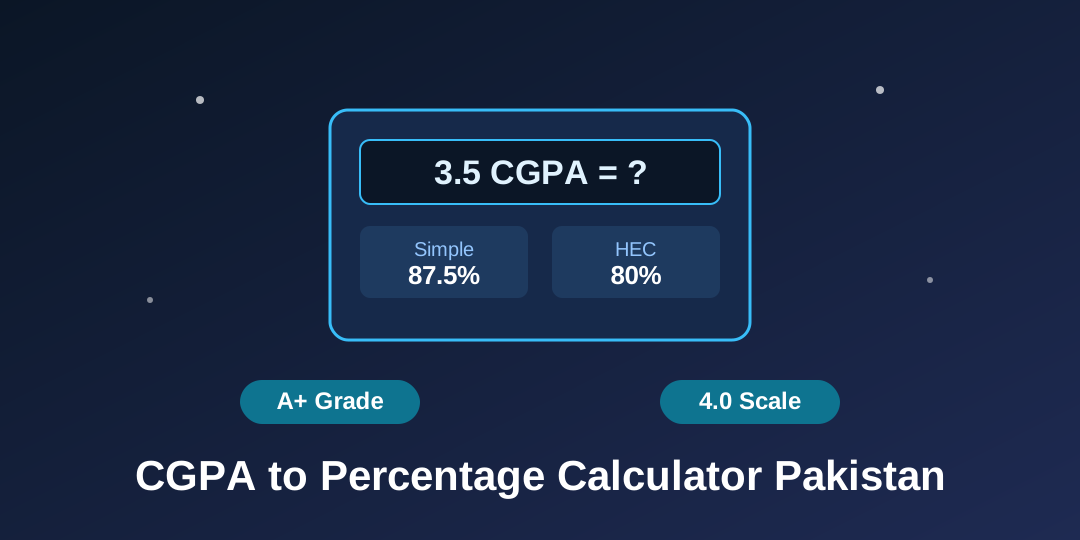
- CGPA 3.5 falls in the 3.34 – 3.66 band, so it converts to 80% — not 87.5%.
- CGPA 3.0 falls in the 2.67 – 3.00 band, so it converts to 71% — not 75%.
- CGPA 2.5 falls in the 2.34 – 2.66 band, so it converts to 68% — not 62.5%.
Side-by-side comparison
| CGPA | Simple (× 25) | HEC band |
|---|---|---|
| 3.50 | 87.5% | 80% |
| 3.00 | 75% | 71% |
| 2.50 | 62.5% | 68% |
The two methods can differ by up to 15 percentage points at the top of the scale, so knowing which one your form expects is not a detail — it changes the number you write.
Why do the two formulas give different answers?
The simple formula assumes the CGPA scale is linear: 4.0 means 100% and everything else scales evenly. That is reasonable for a quick estimate, but it is not how grading bands work in practice. A CGPA of 4.0 does not mean a student scored 100% in every subject — it means they earned the top grade (usually an A) in every subject, and an A typically starts at 85% or 90%.
The HEC table reflects that reality: it maps grade bands to the percentage ranges those grades represent, which is why the top band stops at 85% rather than 100%, and why a CGPA of 2.0 — 50% by the simple formula — sits at 61% in the HEC table.
The wrong formula to avoid: (CGPA − 0.75) × 10
You may come across a third formula circulating on social media and some forums: percentage = (CGPA − 0.75) × 10. Do not use it. It is designed for a different grading system (India's 10-point CGPA scale) and produces nonsense on Pakistan's 4.0 scale.
Test it yourself: for a CGPA of 3.5, the formula gives (3.5 − 0.75) × 10 = 27.5%. A student with a 3.5 CGPA — a strong result by any measure — does not have 27.5%. For a CGPA of 4.0 it gives 32.5%, which is plainly absurd. If you see this formula on a calculator site or blog post about Pakistan, that source has mixed up two countries' systems.
Universities differ — check your own transcript
Here is the complication that catches even careful students: some Pakistani universities publish their own conversion formulas or percentage equivalences on the transcript itself, and those can differ from both the simple formula and the HEC table. A university might state that its 3.5 CGPA equals a specific percentage, or it might print the percentage directly alongside the CGPA.
The rule is simple: your own university's stated conversion outranks any general table. Before you write a percentage on an important form, check the back of your transcript or ask the examination office. If your transcript already shows a percentage, use that number — do not recalculate it.
Also note that the HEC table above is presented as reported by multiple Pakistani education sources citing HEC policy guidelines. Official guidance can be updated, so for a high-stakes application — a scholarship, a government job, or an equivalence certificate — confirm the current table with HEC or your university rather than relying on any single blog post, including this one.
How to convert CGPA to percentage in Pakistan, step by step
- Find your CGPA on your transcript (the cumulative figure, not a single semester's GPA).
- Check whether your university prints its own percentage. If it does, use that — you are done.
- For an official or HEC-related form, find your CGPA band in the HEC table above and use that percentage.
- For a quick estimate or CV, multiply your CGPA by 25.
- Never use (CGPA − 0.75) × 10 — it belongs to a different country's grading scale.
- When in doubt, write both: "CGPA 3.5/4.0 (80% HEC equivalent)" is transparent and defensible.
Which percentage should you write on a form?
It depends on who is reading the form. For HEC equivalence, government jobs, and Pakistani public-sector applications, the HEC band figure is the safer choice, because that is the conversion the receiving institution is most likely to apply itself. For foreign universities, check their instructions first: some ask for the CGPA as-is and do their own conversion, in which case just write "CGPA 3.5 on a 4.0 scale". For a CV, the simple × 25 figure is common, but showing the scale next to it avoids any impression that you inflated the number.
Above all, never mix methods silently. If an employer later verifies your percentage against your transcript and finds a different conversion, the mismatch looks worse than either honest number would have.
Frequently asked questions
What is 3.5 CGPA in percentage in Pakistan?
By the simple formula (× 25), 3.5 CGPA = 87.5%. By the HEC band table, 3.5 falls in the 3.34 – 3.66 band, which converts to 80%. Use the HEC figure for official Pakistani forms and the simple figure only for rough estimates.
What is 3.0 CGPA in percentage in Pakistan?
Simple formula: 3.0 × 25 = 75%. HEC band table: 3.0 falls in the 2.67 – 3.00 band, which converts to 71%.
Is the HEC CGPA to percentage formula the same for all universities?
No. The HEC table is a general guideline, but individual universities can publish their own conversion on the transcript. Your university's stated conversion takes priority for your own degree — always check your transcript or examination office first.
No. The HEC table is a general guideline, but individual universities can publish their own conversion on the transcript. Your university's stated conversion takes priority for your own degree — always check your transcript or examination office first.
Why is (CGPA − 0.75) × 10 wrong for Pakistan?
That formula belongs to India's 10-point CGPA system. On Pakistan's 4.0 scale it gives absurd results — 27.5% for a 3.5 CGPA and 32.5% for a perfect 4.0. Do not use it for Pakistani degrees.
How do I convert CGPA to percentage for a foreign university application?
Check the university's instructions first. Many foreign universities want the CGPA exactly as it appears on your transcript (for example, "3.5/4.0") and perform their own conversion. If they insist on a percentage, use the HEC band figure and mention the method.
The bottom line
Converting CGPA to percentage in Pakistan gives two honest answers: the quick CGPA × 25 method (3.5 → 87.5%, 3.0 → 75%) and the HEC band table (3.5 → 80%, 3.0 → 71%). For official use, the HEC figure is the safer choice; for a fast estimate, × 25 is fine — and the (CGPA − 0.75) × 10 formula should never be used on a Pakistani 4.0 scale.
If you want both figures instantly, without working through the bands by hand, try the free CGPA to Percentage Calculator: enter your CGPA and it shows the simple percentage and the HEC band percentage side by side, so you can pick the right one for your form. For any high-stakes application, confirm the figure against your university transcript or HEC's current guidance before submitting.